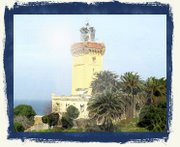
Tangier has long captivated writers and artists, from Matisse to Burroughs.
Stephen Emms from the Guardian goes to see if that artistic spirit lives on in the 'city of dreams'
Samuel Pepys, quite definitely, was not a fan: only Hell itself was worse. Neither was Mark Twain, who desired to leave next day. But for dozens of artists and writers, from Henri Matisse to Paul Bowles, Tangier, on the corner of Africa and Europe, the Atlantic and the Med, has possessed a je ne sais quoi. Its raffish reputation may have dried up since being reclaimed by Morocco in 1956, after decades as an international zone, but, in 2008 is a cultural renaissance again rumbling through the 'city of dreams'?

Tangier is a place to stroll in, not sightsee – there's even an Idler's Terrace (Terrasse des Paresseux), where strollers gaze out at the hypnotic blue beyond – and drifting through the labyrinth of the medina, its appeal to artists becomes clear: the smell of mint and fish wafts through the air, kids soar past, three on a pushbike, and, in sloping sun-lit squares, women in red-and-white shawls and wide hats squat on wooden stools selling mud-fresh vegetables.
I reach Café Central in the Petit Soco, its former literary heart, where, today, snake-like music rattles from tinny speakers and blue parasols dance in the wind. Here, William Burroughs would procure trade for the night (homosexuality being legal in the "interzone"), Tennessee Williams penned Camino Real, and rooms could be rented by the half hour. As I take a seat, a wild-eyed man, arms raised, wails the same phrase over and over. Tangier still has an on-the-brink feeling, I think, sipping my mint tea; if you squint, you might even glimpse the grey spectres of Ginsberg and Kerouac in the corner.

Artistic associations abound at Cafes Baba and Dalia in the Kasbah (frequented by the Rolling Stones) and elegant Gran Café De Paris, in the screech and whir of Place De France (Bacon and Capote). But a thunderstorm hits town, and I decide to explore Tangier's bars: the Windmill, Joe Orton's beachside regular, is now a pizza joint, so, as lightning crackles, I head to the Tanger Inn, where, upstairs, Burroughs wrote Naked Lunch – but now the beats are of the house music variety. Nearby Dean's Bar, whose eponymous owner died from a cocaine overdose in 1963, has a brightly-lit "locals only" feel, while cosiest of all is Atlas bar ("from 1928").
But where is Tangier's spirit? "It's all very private," explains Jean-Luc, Swiss-born manager of Hotel Nord-Pinus, high in the Kasbah overlooking the bay. We sit in the top bar, as the morning sun pours in over Adnet chairs, Berber rugs and Lindbergh portraits. "There's still a social scene here," he says, "but it's discreet, at each other's houses."
The Nord-Pinus, along with other renovations, such as the Dar Nour, run by a French gay couple, represent a newer side to Tangier, that of upmarket resort. There has, of course, always been the pricey El Minzah Hotel, favoured by Rita Hayworth, Rock Hudson and Tennessee Williams, but as the taxi driver said outside the enormous new airport: "Tangier, it's changing."
8

The signs are subtle but everywhere. The proposed road tunnel beneath the Straits of Gibraltar to link Tangier with the Iberia peninsular is due for completion in 2011, though few believe it will actually happen. The Grand Soco, once a thriving market to rival Marrakech's Djemma El Fna, but more recently a car park, was last year refurbed as an attractive garden square with fountains. And the food scene, spearheaded by the glam Relais de Paris restaurant, is impressive, with even budget options like the Darna Women's Co-op (off the Grand Soco) offering delicious lunches. Restored riads such as Nord-Pinus and Dar Nour dish up superb salads and local merlan, while the Minzah has long served fine dourade tajines and pastille au lait.
Festivals have sprung up, too, including the very popular annual Tanjazz festival (May 28 – June 1, tanjazz.org) and 4th Annual Literary Conference (May 16-19, paulbowles.org/janeandpaulbowles.html). One couple at the forefront of "new" Tangier are photographer Yto Barrada and her filmmaker husband Sean Gullette (who co-wrote and starred in Pi), who spent seven years renovating the Rif cinema, on the Soco, into the ultra-hip Cinematheque Tanger. "But it's accessible to all," says 36-year-old Barrada, as she shows me the "international zone-era furniture" of its gleaming WiFi cafe. "Screenings cost 15 dirhams (£1) and we've had people in who've never been to the movies before."
Why Tangier? "The mythology still works here," she says, with a smile. "That's how I persuaded my husband back to my hometown." But Yto admits the struggle for culture over commercialism will be slow-fought. "It's a huge transitional period for Tangier: it's about culture, not leisure."

I'm determined not to leave without meeting Madame Hamri, widow of Mohammed Hamri (the "Picasso of Morocco") and one of Tangier's legendary figures. The rain falls in spikes as Jean-Luc leads me through the white-washed corridors of the Kasbah, passing Dar Zero's famous fig tree (Samuel Pepys' home in 1683), and Bowles' former house, where a cat smirks behind an iron grille.
With a huge smile, Blanca Hamri beckons us on to bamboo chairs in her covered courtyard, canvases covering every last inch of wall, lamps on in daylight. Smoking cigarettes, she says: "You come here and you start a new life," she says. "But strange things happen. There's magic."
A 40-year-old divorcee arriving in 1972, New York-born Blanca was seduced by painter Hamri's "screwdriver eyes" in the flower market. Whisked off to a festival in his home village of Joujouka, she met the gang: Brion Gysin, Tennessee Williams, Ted Morgan, Timothy Leary and Burroughs. "And Paul Bowles soon after," she says, before adding diplomatically, "although I'm not a big fan of his writing." As the tea flows, so do the stories: Tennessee Williams liked Tangier, she says, but really he was "a city boy", while Burroughs was "the most charming man". Finally, I'm beginning to feel the spirit of old Tangier.
"It's a city that will give you what you want," she says, as we stand up to leave. "A wonderful sensibility. In the West everyone wants to move forward, but Moroccans are always in the present time. They're pleased with who they are."
The sky has cleared and the pink sun is setting so, to the sound of the muezzin, I head to Café Hafa, beloved of Bowles et al. On its spectacular terrace overlooking the Straits, I watch a cat curling up on the low wall: "He has a raison vivre," says Mohammed, next to me. "He gets food from the kitchen. He suns himself. He lives.'"
I think of Madame Hamri, who, pondering a fresh golden age for the mythical city, took a long drag of her cigarette, and said: "Who knows who's writing away somewhere?"
Thanks to Stephen Emms.


 The vibrant port of Tangier is an investment hotspot for 2008